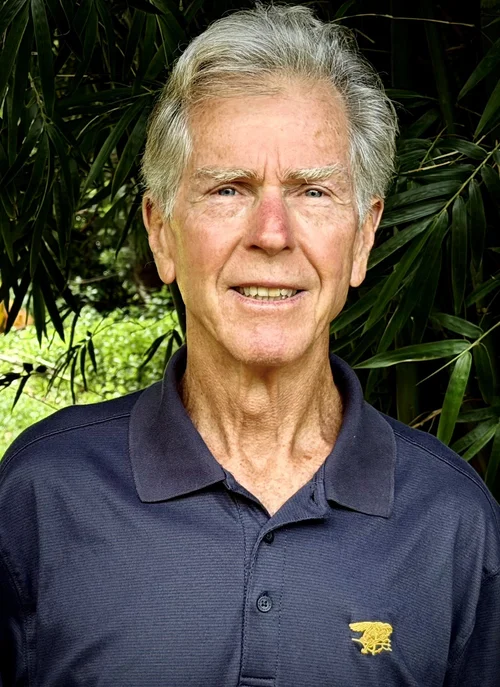
Service, sacrifice, and perseverance
John Dunbar lived in Haʻikū for 36 years. He originally came to Maui as a child for three years and then moved back permanently in 1990. Everything he has done as a Navy SEAL, on the Ironman course, in his business, and in his community reflect his perseverance: he does not stop until the job is done.
Haʻikū Is Home
Haʻikū has been home for John since 1990. He operates a licensed bed and breakfast on his North Shore property where he lives as well. During the pandemic, he opened his doors to residents as a quarantine space and also took in families displaced by the 2023 fires. This is not politics for him. This is his community.
U.S. Navy SEAL
John Dunbar earned the Navy SEAL designation — one of the most demanding military positions in the world. SEALs are a proud tradition. None of them talk publicly about the details of their missions, and John is no different. But when he says he will fight for Maui, he speaks the language of someone who knows what it means to give your all.
— Sports Illustrated, May 14, 1979
The Original Ironman
In February 1978, fifteen athletes gathered in Hawaii for a grueling race no one had done before. John finished second. He came back in 1979 and placed second again. That 1979 race became the subject of a 10-page Sports Illustrated feature that launched the Ironman triathlon as a global sport. The race now has 680,000 annual competitors. From 1994 to 1998, John organized and produced his own Maui triathlon — managing sponsors, logistics, television production, and a broadcast on ESPN — generating an estimated $5 million in economic impact for Maui. He knows how to run complex operations.
Clarifying Some Incomplete Information about John Dunbar Found Online
If you search John’s name online, you will find news articles about initial arrests and convictions. Those articles tell you how the story started. They do not tell you how it ended — all charges were overturned, dismissed with prejudice by the judges, and John’s record was completely cleared in both cases. Do not be misled by getting only the first part of the story.
The conviction. In 2004, John was arrested. At trial, he was acquitted of the two actual charges — Harassment and Resisting Arrest. He was then convicted of attempted escape in the second degree — a charge the prosecution added at the last minute that was never in the original indictment. He was sentenced to probation and received early discharge in 2008. He fought the conviction for sixteen years. In 2021 a court vacated the conviction. With the conviction vacated, the state could have retried John. Instead it dismissed the case with prejudice — permanently, with no possibility of refiling. John P. Dunbar Jr. has no criminal record. — Findings re Vacate Felony Conviction · Judgment re Vacate Felony Conviction · Dismissal of Underlying Charges · Expungement Certificate — Attorney General of Hawaii
The DNA case. In 2014 the State filed a complaint demanding John’s DNA, using his felony conviction as the legal basis. He refused to comply. The case was dismissed with prejudice by Judge Richard Bissen — now the sitting Mayor of Maui County and John’s opponent in the 2026 race — who found the State had no legal authority to demand the sample. The State appealed. The Appellate Court affirmed in a published opinion — State v. Dunbar, 139 Hawaiʻi 9, 383 P.3d 112 (Haw. App. 2016) — with formal Judgment entered October 26, 2016. The conviction the State relied upon as the basis for the DNA demand was subsequently vacated. — Trial Court Order Finding DNA Demand Unlawful · Appellate Court Affirmance of Trial Court DNA Order · Appellate Court Judgment